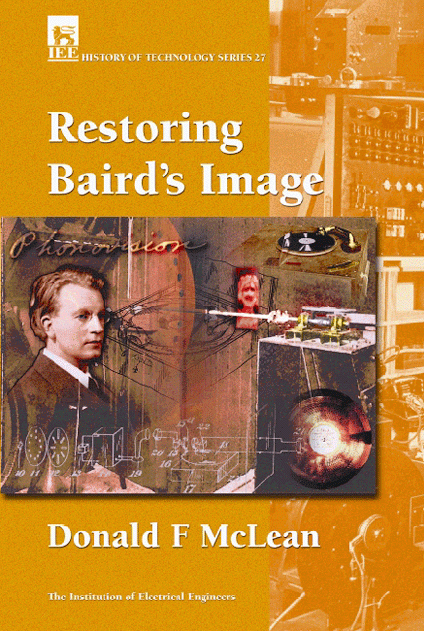
Front Cover Restoring Baird's Image
D
onald F McLean

Special Commendation : 2001 Kraszna-Krausz Awards (see below)

Hardcover - 295 pages, 150 half-tones
Institution of Electrical Engineers; ISBN: 0 85296 795 0

Cover design (left) © IEE 2000
Click image to enlarge


Comment

Announced 5th February 2002, in a Press Release for the 2001 Kraszna-Krausz Moving Image Book Awards, "Restoring Baird's Image" was one of two books awarded a Special Commendation in the Business, Techniques and Technology category from an overall shortlist of 25 from over 250 books submitted internationally. The judges described it as "a marvellously revealing account, a testament to Baird's visionary contribution to thinking about how the moving image might be accessible in recorded form more than half a century before the advent of the commercial video disc."


Synopsis

Reviews

Orders


Synopsis (back cover text)

"John Logie Baird, Britain’s foremost television pioneer, experimented with video recording onto gramophone discs in the late 1920s.  Though unsuccessful at the time, his experiments resulted in several videodiscs, some 25 years before the videotape recorder became practical.  These videodiscs – called Phonovision – remained neglected over the decades, considered by experts as unplayable.

In the early 1980s, the author sought out and restored the surviving Phonovision discs. Using computer-based techniques in an investigation reminiscent of an archaeological dig, the author has not only revealed the images on the discs but also uncovered details of how the recordings were made. The Phonovision discs have now become recognised as one of Baird’s most important legacies.

In 1996 and 1998, amateur ‘off-air’ recordings of the BBC’s 30-line Television Service (1932–35) were found, giving us our first view of what viewers were then watching. The author’s restoration overturns established views on mechanically scanned television, providing us today with a true measure of Britain’s heritage of television programme-making before electronic television.

As well as helping to explain a poorly understood and complex period in television’s history, this unique book, heavily illustrated with previously unpublished or rarely-seen historic photographs restored by the author, sheds light on the achievements of Baird, the development of video recording and the definition and invention of television itself."

©IEE 2000

Also you can read the synopsis and detailed description at the IEE website.


Reviews


EXTRACT from FULL REVIEW:

"Ask most Britons who invented television and the answer will come John Logie Baird. Far fewer could tell you what he achieved and when, however, and it’s precisely that haziness that this new book serves to clarify.

What’s more, Restoring Baird’s Image does it remarkably well, covering not only Baird’s contribution to television and allied sciences but providing a conspectus in miniature of television development down to present times, whiles still keeping its subject within bounds. Moreover, the author’s passion for his subject (and scholarship) shine clearly through, making this book the most authoritative book on Baird’s work yet published."

copyright British Journal for the History of Science. Vol 34 Pt 2, No 121, June 2001

"Scholarly research and "can't put it down" writing are rare companions. Don McLean has succeeded magnificently in conveying the excitement of unearthing and restoring recordings of Baird's 30 line TV pictures.

It would be picking at the tiniest nits to say that the title is a little misleading. The heart of the book is undoubtedly the discovery and restoration of the recordings of Baird's 30 line images but there is much more than this. A brief but perceptive tour of the history of imaging and television, a review of later video recording systems and important thoughts on the problems of archival permanence are all valuable elements whose presence is not suggested by the title.

The writing style may be informal but McLean's treatment is rigorous. Due care taken to separate fact from opinion and I have little doubt that the historical details are as accurate as diligent research allows. The selected bibliography brings many useful references together in one place. I cannot really gripe about the very small number of typographical errors which do not mislead the reader. 

The main conclusion of McLean's work is to revise our views on the Baird 30 line transmissions. It is now clear that they were much more than crude engineering experiments and contained material of real entertainment value. In the world of history "revisionism" is often a dirty word. In this case our attitude towards Baird should have been changed as a result of genuinely new evidence. 

I have only one significant criticism. Much of the quality of Baird's images is only apparent on moving images. Blame the lack of a CDROM on the IEE, not the author. Web addresses are ephemeral but you can see the moving images at http://www.dfm.dircon.co.uk/. The IEE has published this book at a relatively affordable price and it deserves to reach a wider audience than would normally buy IEE publications.

Buy, read and enjoy."

copyright Jeffrey Borinsky MIEE CEng and BVWS (British Vintage Wireless Society) November 2000

"As the title suggests, this book deals largely with the retrieval and restoration of Baird’s 30-line television pictures recorded on shellac and aluminium discs over the period 1927-35.
     Many authors writing about the history of television are faced with the difficulty of finding something new and prefer not to quote too often from earlier accounts written by other people. Donald McLean manages to avoid most of these problems since he is in the unique position of being able to describe a form of television archaeology never attempted before.
     Written in a conversational style, this book covers a considerable amount of new ground. It is copiously illustrated and 40 of the photographs have never been published previously.
     The flavour of the infant years of television is captured most successfully and the book represents essential reading for everybody with an interest in those days."

Ray Herbert,
Baird historian,
(extracted from NBTVA newsletter, August 2000)
(Click for FULL UNEDITED REVIEW)

"In 'Restoring Baird's Image' the author has given a fascinating account of his discovery of the recordings and of his subsequent treatment of their images. The latter is an outstanding example of 'television archaeology'."


Engineering Science & Education Journal, Feb 2001

"Don McLean has presented a revision of the history of television presenting a new perspective on the work of Baird, the inventor of ‘failed’ technologies. I have long thought that history written from the perspective of 'successful' technologies is an unnecessarily restricted exercise. It is too easy to dismiss 'yesterday's technology' as misguided, primitive, crude, and leading into blind alleys and so on.
      McLean’s work is interesting on several levels, ranging from the representation of Baird and his work to a truly fascinating account of the discovery of and the unraveling of the content of early video recordings.
      This lively and engaged work presents the history of television in a way rarely seen, and introduces a new approach to an understanding of the process of invention that Baird applied."

Dr Colin A Hempstead, 
Visiting Research Fellow, 
School of Law, Arts and Humanities, 
University of Teesside

"I must admit that when I first received this book, I thought it would be just about the restoration of images from the original Baird Phonovision recordings. Well, it is much more than that. It reads more like a television history book, all connected by Baird and his recordings. 
If you read this book, you will have a much better appreciation for Baird's contributions to television as well as for the work it took for Don Mclean to bring back these images to us in real time. This is a fascinating book, once you start, you won't want to put it down. 
The book contains a large number of photos and illustrations, many of them the first time in print and all of them of the very best quality. I recommend this book to you highly."

Peter Yanczer
Warson Woods, Missouri,
USA
(from review page on Amazon.com, October 2000)

Engrossing...if you are technically minded
I found this book difficult to put down. After reading on Mr Mclean's website about his restoration of Baird 30 line discs I waited some time for this, more technical, description of the electronic archeology involved.
For anyone like me who wants to know the details of what Donald has achieved and how he did it, this book is fascinating. For less technically minded folks it has many sections which are still very interesting and lots of pictures and illustrations. All in all a fabulous book, written in a friendly style which will stand as a landmark publication on early television. For the first time we know for sure something about what the earliest transmitted TV programmes were like, their content and technical quality. We also have direct evidence of problems Baird faced in developing his TV system and how he attempted to overcome them.
McLean is restoring Baird's image in more senses than one, not only has he restored 70 year old video discs, he has also restored the reputation of Mr Baird and his television system.


a_gulliver@ntlworld.com
(from review page on Amazon.co.uk, 16th Feb 2001)

WOW WHAT A BOOK!!! For all you 30-line television afficianados the images in this book are GREAT!! the images of Betty Bolton, "Stookie Bill" and Miss Pounsford are even better than on the author's web site. Highly Recommended for any lover of early television.

Review by Mike Zolotorow, of Baltimore, MD as it appeared in full on Amazon.com May 2007,


Orders

The book is not available through me. However...

Ordering through the IET is world-wide and can be made by direct ordering below.

UK and Global Availability - Online searches for Price Comparison

These will do an automatic search of online booksellers and compare availability and price information.

UK and Global Availability - Direct ordering

The following links are hot-wired to the page for my book:


Back to Main Page

All material in this page is copyright ©DFMcLean 2002 except where specified.


Last updated by Don McLean on 19-May-2007